
Lee County Probate Jurisdiction
Lee County Probate Court is separate from the Circuit Clerk and District Court. Probate Judge Jere Colley leads the office. Its formal jurisdiction includes admitting wills, appointing estate representatives, issuing letters, replacing or removing representatives, and overseeing guardianships and conservatorships. The court also hears adoptions, involuntary mental-health commitments, condemnation petitions, name changes, and legitimation matters.
The official Lee County Probate Court jurisdiction page identifies these functions.
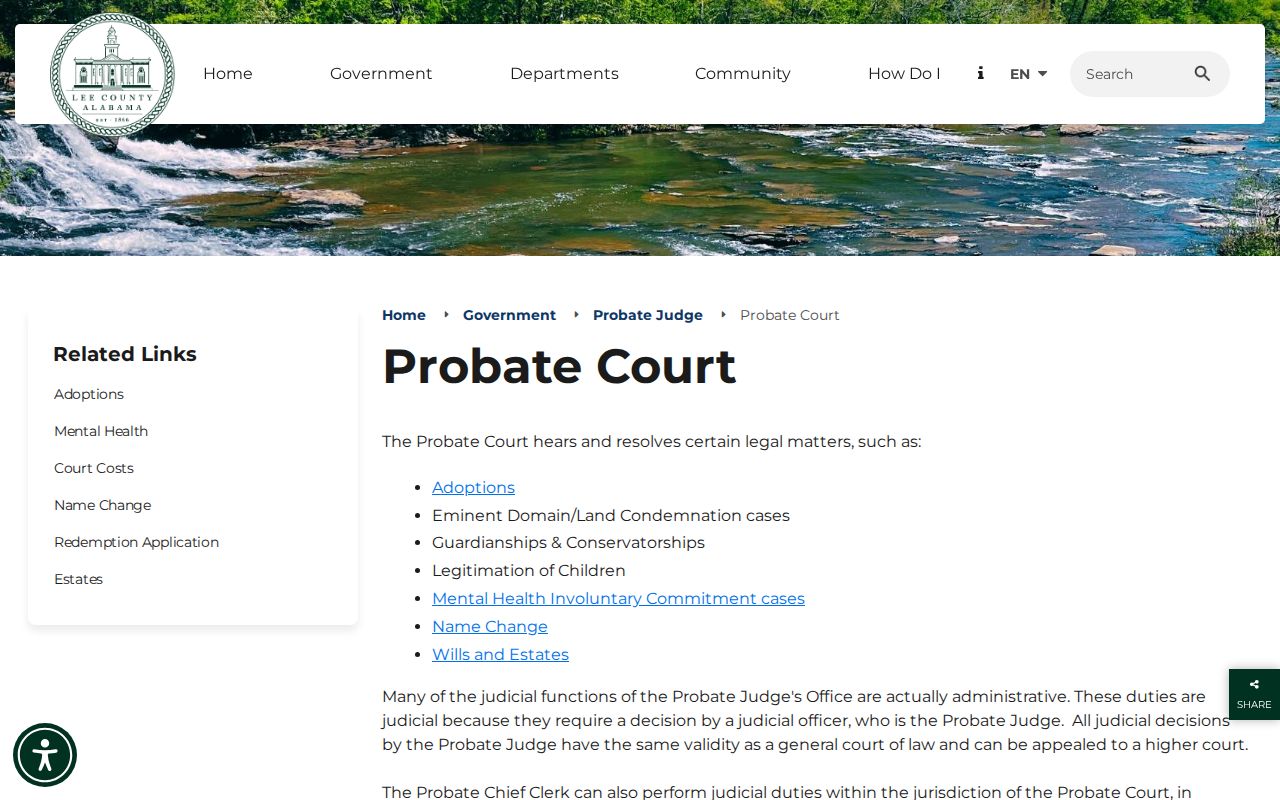
The breadth of that authority explains why the office holds much more than estate and will records.
- Wills and estates: probate, executor or administrator appointment, and estate administration.
- Guardianships: authority for care decisions involving a minor or protected adult.
- Conservatorships: authority for management of a protected person's property or finances.
- Name and family matters: name changes, legitimation, and adoption proceedings.
- Commitments and condemnation: specialized hearings within probate jurisdiction.
Contact Lee County Probate Court
The main Probate Court and recording offices are downtown at the Lee County Courthouse. The Probate Judge publishes a post-office box, direct phone, and email. Auburn and Smiths Station satellite offices serve county residents, but the research does not confirm that every judicial probate filing can be made at a satellite. Call before taking an estate, guardianship, or other court petition to one.
Lee County Probate Court
215 South 9th Street
Opelika, AL 36801
(334) 737-3660
Monday-Friday, 8:30 a.m.-4:30 p.m.
Probate Judge Jere Colley
PO Box 2266
Opelika, AL 36803-0811
(334) 737-3670
jcolley@leeco.us
Auburn Satellite Office
1266 Mall Parkway
Auburn, AL 36830
(334) 737-7297
Monday-Friday, 8:30 a.m.-4:30 p.m.
Smiths Station Satellite
2336 Lee Road 430
Smiths Station, AL 36877
(334) 448-3299
Monday-Friday, 9:00 a.m.-4:30 p.m.
The Lee County Probate Judge office page provides the official office and leadership details.
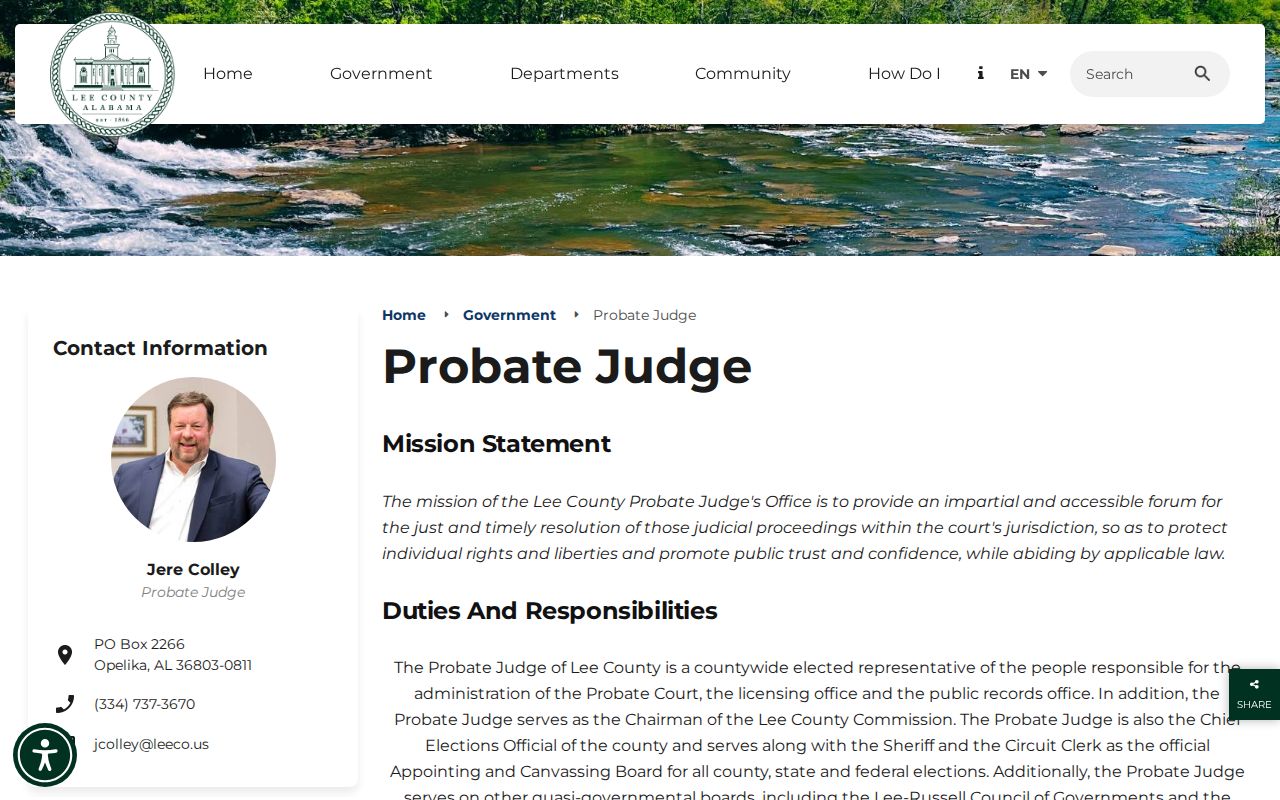
The page also reflects Jere Colley's transition into the office after Judge Bill English's 2001 through 2025 service.
Find Lee County Probate Records
No official online Lee County probate case database was documented in the research. Probate case questions therefore start with the Probate Court by phone or in person. State probate forms can be found through Alabama AOC eForms, but a blank form is not a case lookup and does not prove that it fits a specific filing.
Recorded public documents use a clearer access path. The recording office provides public viewing stations. Staff can help an in-person visitor search by name. A mailed or in-person copy request should include recording information, book and page, and recording date when known. Those details help staff locate the correct document faster.
| Channel | Best use | What to provide |
|---|---|---|
| Probate Court phone | Case status, filing route, fee or form questions | Case or party name and record type |
| In-person probate visit | Probate case request or filing | Names, case details, and identification if required |
| Public viewing station | Recorded documents | Name and known recording details |
| Mail copy request | Copy of a recorded instrument | Written request, fee, book/page, and date if known |
| Alabama AOC eForms | Official state probate forms | Confirm the form and filing rules with Lee Probate |
Lee County Recorded Documents
The Probate Judge's recording function records, indexes, and preserves permanent public documents, mainly real estate records. That work is related to the Probate Judge's public-record duties but is not the same as an estate docket. A deed, mortgage, or other recorded instrument is found through recording data rather than an estate case number.
The official Lee County recording office page explains the viewing stations and copy methods.
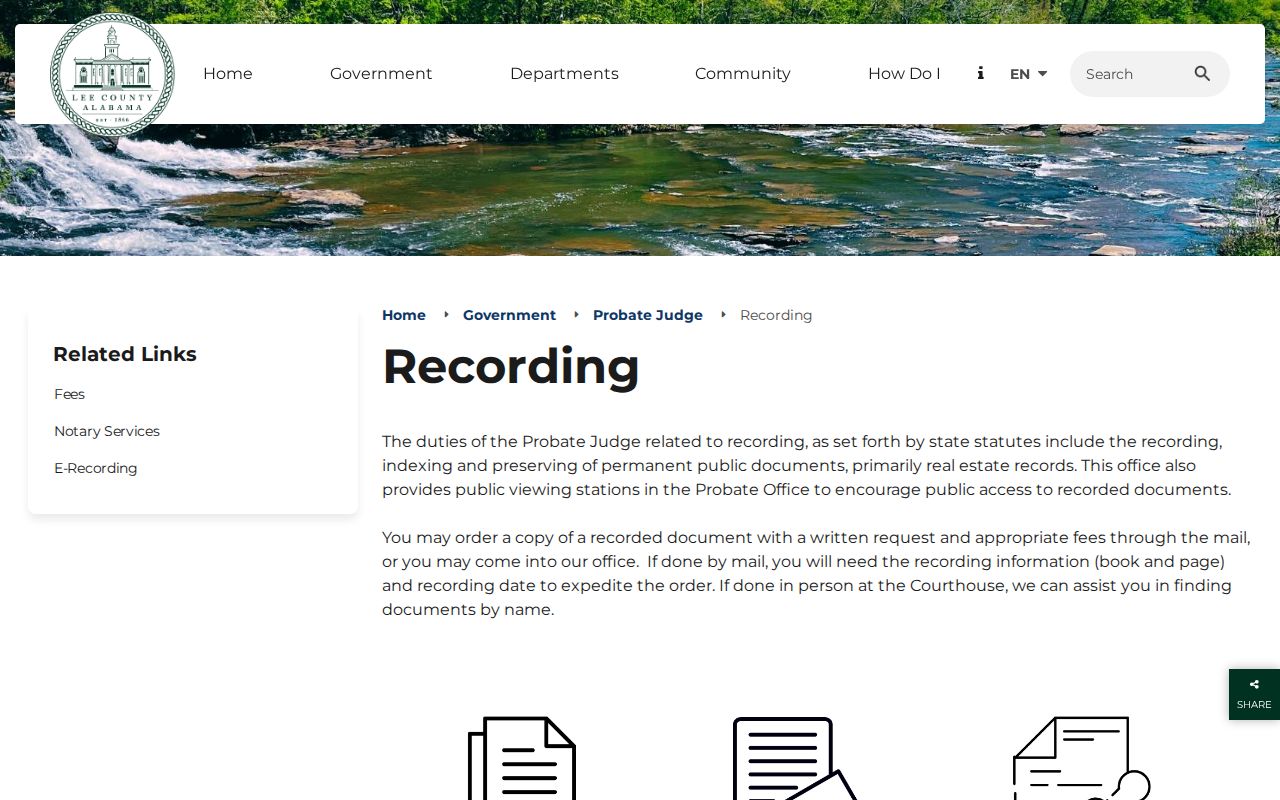
Use that recording channel for permanent public instruments and the Probate Court channel for judicial probate files.
Important: Book, page, and recording date identify a recorded instrument, while a probate case may use party and case information.
Lee County Estate Record Path
An estate starts by determining whether the person left a will and whether Lee County is the right venue. The court can admit a will and appoint an executor, or appoint an administrator when there is no will. If approved, the court issues letters showing the representative's authority.
- Locate the original will, if one exists, and identify the proper probate venue.
- File the will and petition with Lee County Probate Court when Lee County is proper.
- Ask the court to appoint the named executor or an administrator for an intestate estate.
- Obtain letters testamentary or letters of administration if the court approves the appointment.
- Complete notices, claims, inventory, accounting, asset, and distribution work required under Alabama law.
- Request certified probate documents or recorded copies in person or by mail as needed.
Probate staff cannot give legal advice. The county warns that probate law and procedure are complex and advises people to seek an attorney. Staff can explain office procedures and accepted forms, but they cannot choose a legal course for a filer.
Lee County Probate Terms
Probate terms describe the person who died, the people managing the estate, and court protection for others. Knowing the terms makes an index, order, or letters easier to read.
- Testator
- A person who made a will.
- Executor
- The person named or appointed to administer an estate under a will.
- Intestate
- Dying without a valid will.
- Administrator
- A person appointed to administer an intestate estate.
- Guardianship
- Court authority focused on care and personal decisions for a protected person.
- Conservatorship
- Court authority focused on a protected person's property or finances.
Letters testamentary apply to an approved executor. Letters of administration apply to an approved administrator. Banks and other institutions may ask for a certified copy to confirm current authority.
Verify Lee County Probate Fees
The official Lee County sources reviewed did not publish a complete Probate Court fee schedule. They also did not document a local online case-search charge, will-safekeeping fee, or full estate filing table. Do not rely on a Circuit Clerk fee list for Probate Court because the offices and record systems are separate.
| Service | Published amount | Action |
|---|---|---|
| Probate case filing | Not provided in research | Call Probate Court before filing |
| Recorded-document copy | Appropriate fees required, amount not provided | Confirm amount and payment method with recording staff |
| Certification | Not provided in research | Ask whether certification is needed and obtain a quote |
| Probate form | Not provided in research | Verify current form and related filing charge |
Call (334) 737-3660 or (334) 737-3670 for a current amount, accepted payment type, and filing checklist. A written copy request should not be mailed with an assumed payment.
Restricted Lee County Probate Files
Estate records and recorded instruments may be open subject to redaction, but not every probate matter has ordinary public access. Adoption files are restricted. Involuntary commitment matters include sensitive mental-health information and must also be treated as restricted. Guardianship and conservatorship files can contain private medical and financial facts.
Ask the Probate Court what proof, party status, or court order is needed. Public-record principles do not override a specific confidentiality rule. The office may provide a public portion, redact protected data, or deny access to a sealed part.
Marriage certificates use their own recording and vital-record process. For that path, use the Lee County marriage and divorce records information rather than an estate request.
Lee County Probate Judge Duties
The Probate Judge has an unusually broad county role. Jere Colley administers Probate Court, the licensing office, and the public records office. The Probate Judge is also chair of the Lee County Commission and Chief Elections Official. Along with Sheriff Jay Jones and Circuit Clerk Mary B. Roberson, the judge serves on the county Appointing and Canvassing Board.
This structure explains why one county department includes judicial probate work, licenses, recording, elections-related duties, and commission functions. The request still needs to be routed by record type. Court staff handle the probate case, while recording staff locate recorded public instruments.
Lee County also publishes a long line of prior probate judges dating to David Read's 1867 term. More recent continuity includes Ira Weissinger Sr. from 1950 through 1977, I.H. "Hal" Smith from 1977 through 2001, and Judge Bill English from 2001 through 2025. Colley's biography adds service as Lee County's first family court clerk, juvenile contract attorney, and an appointed presiding officer in juvenile and child-support matters before his probate role.